Background
 Strategic Funding Advisor
 Firm Expertise
 Practical Experience
 Legendary Customer Service
 Closed Deals
 Testimonials
 Business Funding
 Acquisition Funding
 Mezzanine Funding
 Advisory
 Mezzanine Funding
 Mezzanine Expertise
 Mezzanine Tools
 Acquisition Funding
 Acquisition Funding Expertise
 Advisory
 Case Studies
Limited capital has never stopped a smart entrepreneur from securing acquisition financing. Lenders evaluate the overall strength of the transaction, the buyer’s experience, and the value they bring to the deal—not just the size of their cash contribution.
Many buyers assume acquisition financing works like purchasing real estate, where a large cash down payment is mandatory. In reality, acquisition financing lenders take a much more flexible approach. While they generally expect the entrepreneur to invest some capital in a new acquisition, the required amount depends heavily on the structure and quality of the transaction.
How Deal Structure Influences Acquisition Financing
If the purchase price is attractive and the seller is willing to provide a large, fully subordinated seller note, the acquisition financing lender may allow the entrepreneur to contribute a much smaller equity investment. In many cases, this can range from 10% to 15% of the purchase price, provided the investment is meaningful relative to the buyer’s overall net worth. Typically, lenders look for the entrepreneur’s equity contribution combined with the seller note to represent approximately 25% to 35% of the total purchase price.
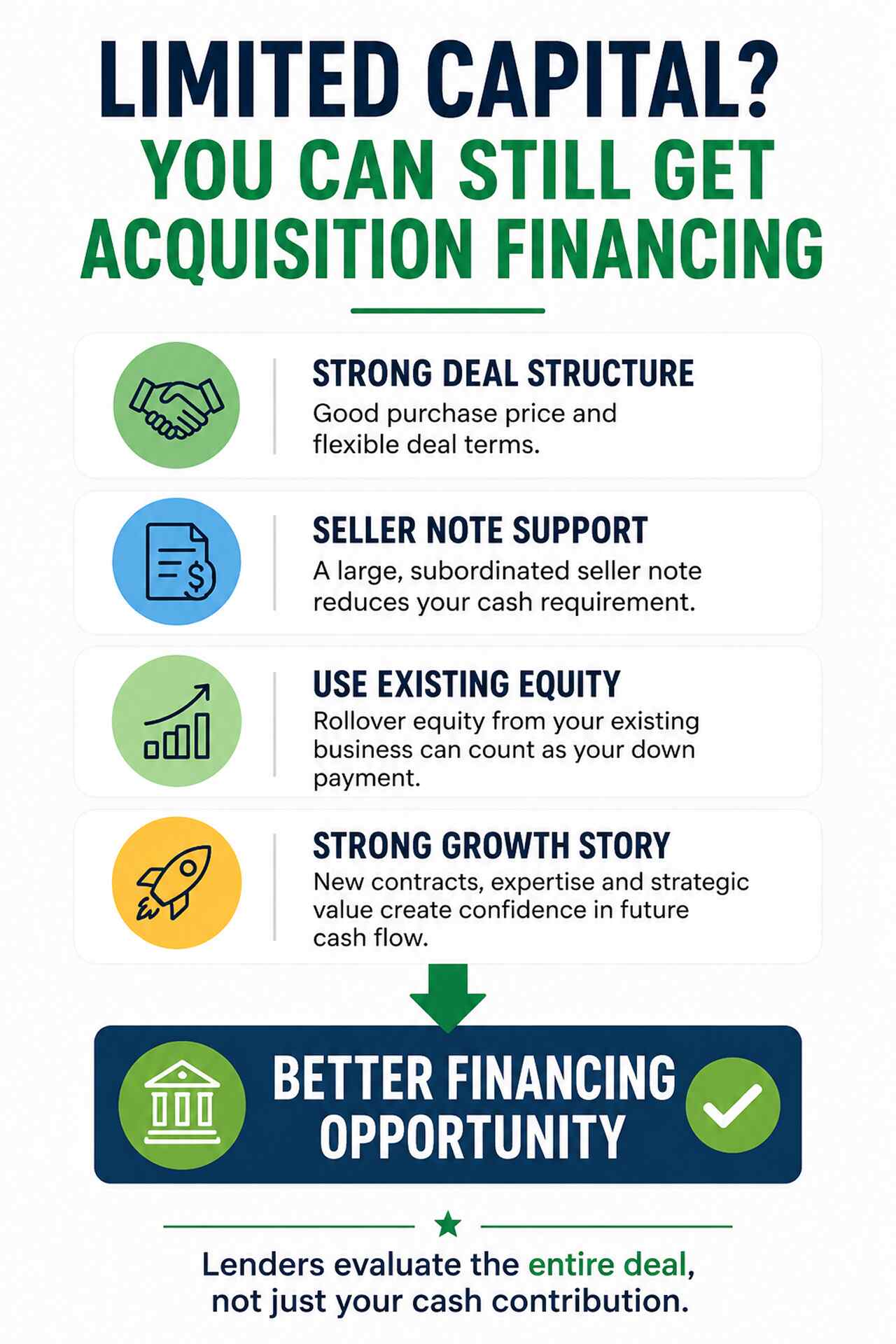
Entrepreneurs who already own a business may have another advantage. If their existing company has meaningful market value, that equity can often serve as the down payment for the acquisition. Rather than requiring additional cash, the lender may accept the buyer’s rollover equity as their investment in the transaction.
Successfully using rollover equity requires demonstrating its true market value. This is usually accomplished through comparable company valuations and exit value analysis that clearly illustrate the business’s underlying equity value and help lenders recognize its contribution to the transaction.
Lenders also recognize value beyond balance sheets. Signed customer contracts, new revenue opportunities, industry expertise, proprietary relationships, or other strategic advantages the entrepreneur brings to the acquisition can strengthen the financing request. These factors create a compelling growth story that gives lenders greater confidence in the business’s future cash flow and long-term equity value, making acquisition financing more achievable even when the buyer has limited cash available.