Background

 Strategic Funding Advisor

 Firm Expertise

 Practical Experience

 Legendary Customer Service

 Closed Deals

 Testimonials

 Business Funding

 Acquisition Funding

 Mezzanine Funding

 Advisory

 Mezzanine Funding

 Mezzanine Expertise

 Mezzanine Tools

 Acquisition Funding

 Acquisition Funding Expertise

 Advisory

 Case Studies

Acquisition lenders tend to be birds of a feather when it comes to risk assessment. When new funds are coming online in the private credit industry and competition for good deals is fierce, they are accommodative and find reasons to do deals. When the economy goes sideways and funds are in wait and see mode, they are more cautious about leverage multiples in their deals.
This can result in a sudden ratcheting down of leverage by half a turn or even a full turn. Usually, this type of pulling back of leverage presages problems ahead in the market.
While pulling back leverage a half a turn sounds like a mere nip to the structure, it has outsized impact on the level of capital due to the multiplier effect. If EBITDA is $10 million and I was expecting 4 times leverage but now can only raise 3.5 times, I am $5 million short in my sources and uses. This level of pullback, which the market may see very soon, results in 12% decrease in proceeds and blows a hole through the structure.
The worst place for a buyer to be is to be down the road with a seller only to realize they cannot close because of this capital gap. These moments require fortitude, ingenuity and resourcefulness as there are several ways to close the gap without losing the deal.
How to Close the Gap When Acquisition Lenders Pull Back
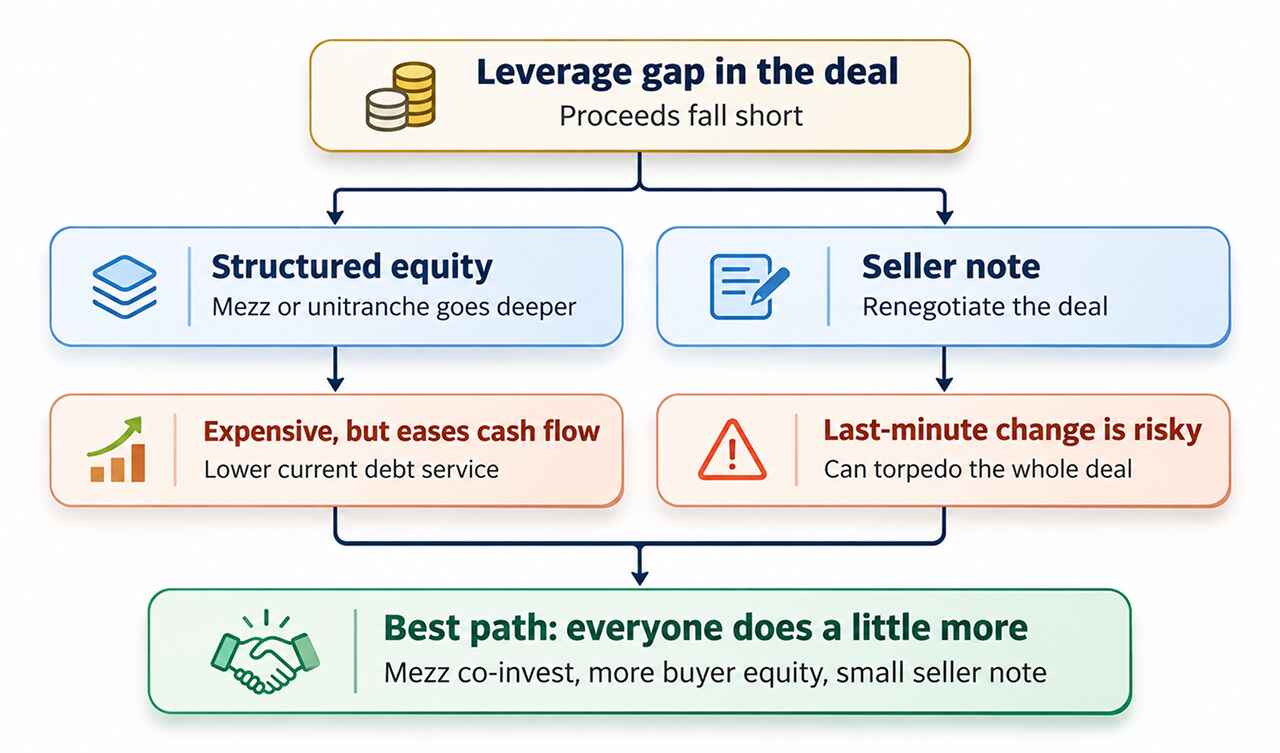
Mezzanine or unitranche players, if pre-structured in the deal, can go deeper into the capital stack and provide various types of structured equity or preferred equity. This will be expensive, but it also may decrease current debt service which helps cash flow.
Structured equity providers are a good source of capital as they attack the deal from the bottoms up and are used to cohabitating with acquisition lenders. They provide useful long-term capital that provides ballast to capital structure for stability. Rotating away from acquisition loan to structured equity may give you a healthier structure and plug these proceeds gap at the same time.
Renegotiating the deal and leaving a seller note in the deal is another popular move though last-minute changes like this can torpedo the whole deal.
The best and most harmonious path to solving this leverage gap is for all players to be creative and do a little more. The mezzanine lender can put in some equity co-invest, the buyer can put in more equity, and the seller can take a small seller note.