Background
 Strategic Funding Advisor
 Firm Expertise
 Practical Experience
 Legendary Customer Service
 Closed Deals
 Testimonials
 Business Funding
 Acquisition Funding
 Mezzanine Funding
 Advisory
 Mezzanine Funding
 Mezzanine Expertise
 Mezzanine Tools
 Acquisition Funding
 Acquisition Funding Expertise
 Advisory
 Case Studies
The eternal tension in acquisition structuring is balancing operational liquidity with leverage levels. Buyers often invade the operational debt capacity of a business to fund the purchase price, creating untenable long-term liquidity.
Payment in kind toggle structures have become an important liquidity management tool in acquisition financing, particularly in private credit transactions where preserving cash during the early stages of ownership is critical. Instead of paying all interest in cash, borrowers can temporarily capitalize a portion of interest into the loan balance, helping maintain liquidity while integrating an acquisition or executing a growth strategy.
Structural payment-in-kind toggles are a way to mitigate financial stress and partially defend operational liquidity. Most acquisition lenders in the private credit industry offer them and they should be used at all times.
Inserting flexible interest switches creates a buffer for companies during tough times. Payment-in-kind toggles permit interest deferment, which is particularly valuable if a company needs to shore up their internal liquidity. These can be toggled on or off depending on the current performance outlook.
Some payment-in-kind toggles apply to a portion of the interest payment, and some apply to the entire interest payment. Companies should not over-rely on them as they are not a panacea to a permanent hole in working capital.
They help on the margin and deliver some relief to an embattled company whose debt service is pounding away. Ultimately, if the company is upside down with operational liquidity, the margins for underperformance are very narrow.
Structural Payment-In-Kind Toggles and Liquidity
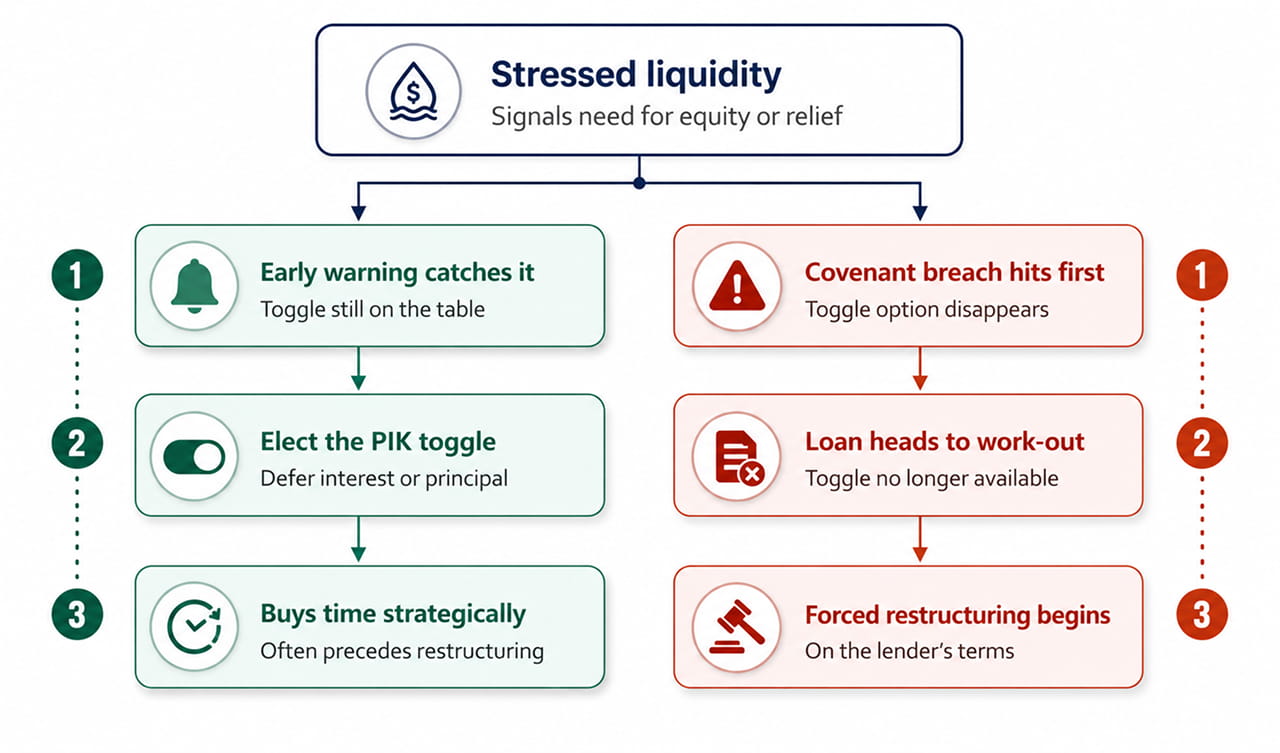
Underperforming companies with stressed operational liquidity ultimately need an infusion of equity capital to reliquefy the balance sheet. Structural pay-in-kind toggle can also apply to principal repayment where the borrower receives a principal holiday.
In reality, borrowers with bad performance and stressed liquidity usually breach a covenant on their way to a lender default. Should this occur, the borrower no longer has the ability to elect a toggle, and the loan ends up in work-out.
Taking advantage of this toggle benefit comes down to a company’s ability to forecast problems before they occur. An early warning system can signal the best time to toggle, while a covenant default is still far off in the distance.
The toggle usually is the prelude to a larger scale principal and interest restructuring.