Background
 Strategic Funding Advisor
 Firm Expertise
 Practical Experience
 Legendary Customer Service
 Closed Deals
 Testimonials
 Business Funding
 Acquisition Funding
 Mezzanine Funding
 Advisory
 Mezzanine Funding
 Mezzanine Expertise
 Mezzanine Tools
 Acquisition Funding
 Acquisition Funding Expertise
 Advisory
 Case Studies
Mezzanine structures are built upon revenue visibility and cash flow stability.
When a company knows for certain that revenue is showing up every year at a good margin, it has a repeat book of business which derisks future cash flow for the mezzanine lender.
This matters a great deal to the quality of the mezzanine structure a company can qualify for.
Recurring revenue businesses are valued a higher multiple than non-recurring revenue businesses for good reason.
When a large amount of revenue is recurring, the company has a higher degree of earnings predictability and a lower risk of earnings misses.
Mezzanine lenders, who are completely cash flow driven, highly prize this.
Mezzanine Debt Structures for Recurring Revenue Businesses
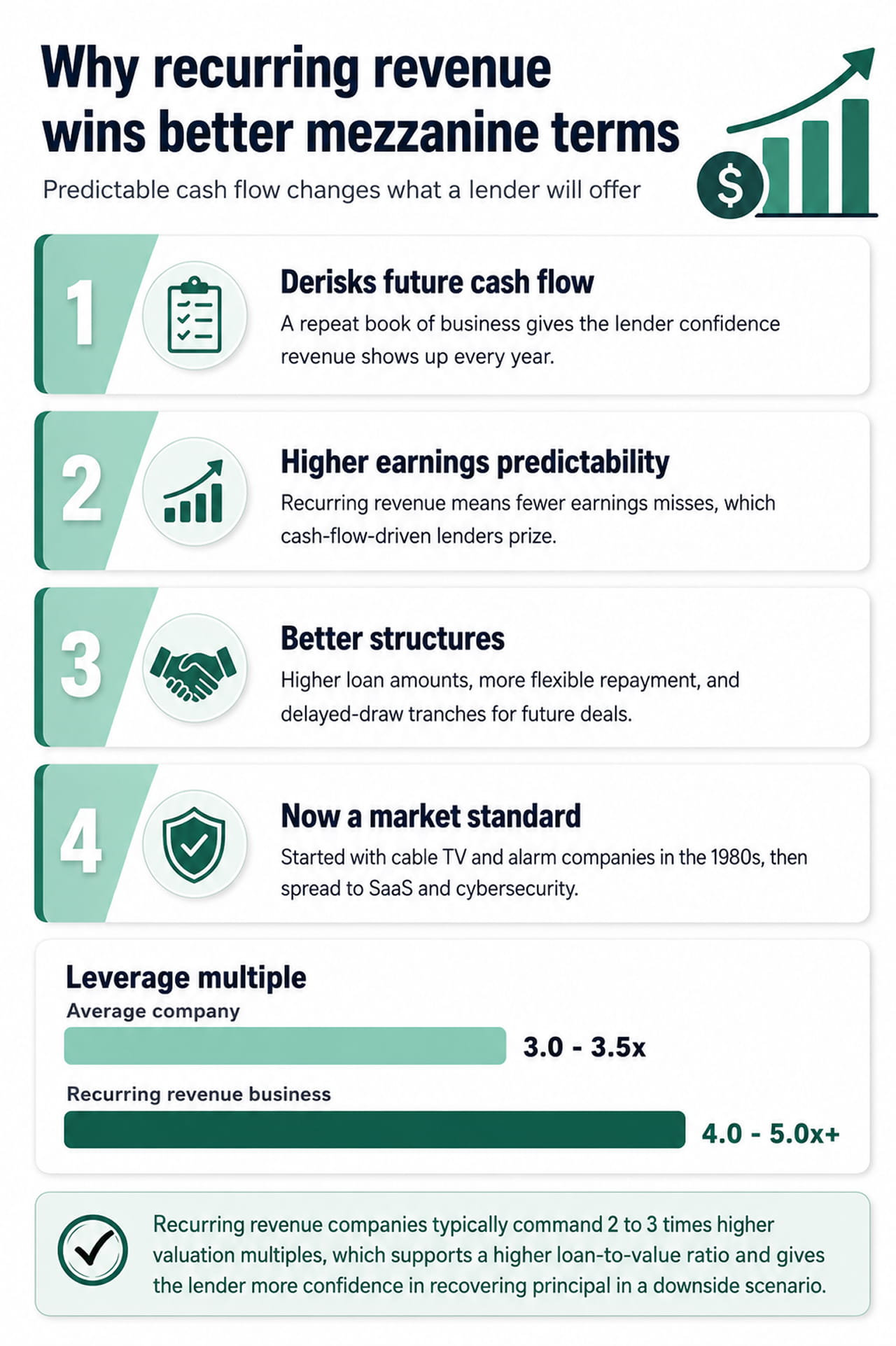
Companies usually receive better mezzanine structures in the form of higher loan amounts, more flexible repayment and delayed-draw term loan tranches that can be used for future acquisitions.
The recurring revenue lending craze began in the 1980’s with cable TV and security alarm businesses and expanded into the technology sectors such as SAAS and Cybersecurity.
Banks and finance companies established dedicated businesses to focus on these areas, which elevated the concept of recurring revenue to a market standard.
This resulted in many new companies adopting an everything-as-service revenue model to justify lofty lending multiples and generous mezzanine structures.
Mezzanine structures for recurring revenue businesses are at significantly higher leverage multiples than the average.
Whereas leverage multiples range from 3.0 to 3.5 times for average companies, recurring revenue multiples start at 4.0 times and extend into the 5.0+ region.
This reflects a few mezzanine structure fundamentals.
These Companies receive 2 to 3 times higher multiples in valuation.
They are worth more, so they justify a higher loan to value ratio.
They also have more staying power with respect to long term cashflow generation, giving the lender a better chance of recovering its principal in a downside scenario.