Background
 Strategic Funding Advisor
 Firm Expertise
 Practical Experience
 Legendary Customer Service
 Closed Deals
 Testimonials
 Business Funding
 Acquisition Funding
 Mezzanine Funding
 Advisory
 Mezzanine Funding
 Mezzanine Expertise
 Mezzanine Tools
 Acquisition Funding
 Acquisition Funding Expertise
 Advisory
 Case Studies
Companies involved in a mezzanine debt financing undergo quality of earnings (“QoE”) testing by smart accountants who are trained in spotting things most investors cannot see. These accountants usually have full knowledge of all of the sloppy and non-conforming accounting practices used by closely held middle market companies.
When companies are private and do not financially report their results to an investor stakeholder, they have the liberty to account for things in a variety of ways as long as their tax reporting is accurate. Often this means that companies are not fully aware of how far from the standard level of GAAP compliant accounting their books are.
Mezzanine debt lenders need GAAP level accounting as well as books that measure up to financial, planning and analysis (“FPA”) standards.
When the QoE Reshaped a Mezzanine Debt Deal
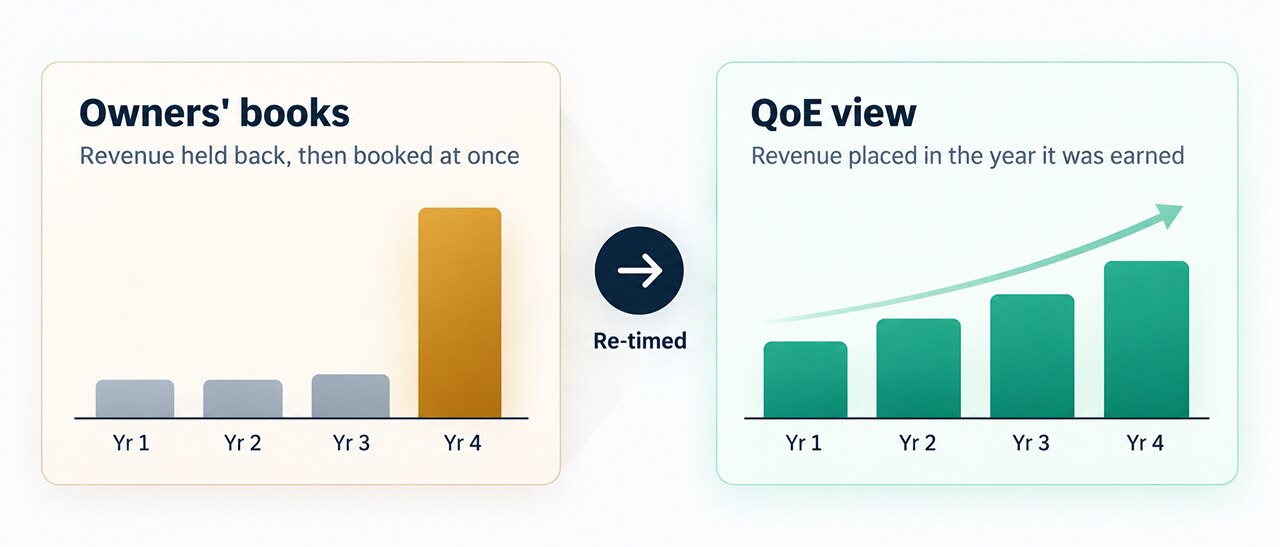
One company began this process believing that their EBITDA was so high that the QoE would be a breeze. For the longest time, the owners delayed revenue recognition for tax purposes which resulted in a large spike in EBITDA at project cycle end. This was an ingrained process of the company, and the owners did not spend the time understanding how their financial reports would look if they had used GAAP-based progress billings to approximate percentage completion.
Critically, the owners did not communicate this adequately to their investment banker or their new mezzanine lender early enough so that the QoE firm was aware.
The QoE showed a much different picture than the company’s internal numbers by putting each project back in the appropriate year it should have been recognized as revenue. This fixed the inherent mismatch between when revenue should have been recognized versus when it had been initially recognized. The owners did not see this coming and were very concerned that large projects would fall outside of their training twelve-month period used for valuation.
Their investment banker ultimately was able to see that their existing work in process was significant enough so that any loss in delayed revenue recognition pushed back to prior years would be made up by current work in process which could be revenue recognized. This was conveyed to the mezzanine debt lender and their accountants who appreciated the insight and were able to complete their work and see that the current work was at a sustainably high level to gap any historical shortfall.
This type of revenue conversion happens all the time with QoE processes and as long as companies can explain what they are doing and why they are doing it, it usually ends up well. It is when the QoE firm is not guided as to the Company’s accounting practices, where deals suffer and die at the hands of the QoE firm
.