Background
 Strategic Funding Advisor
 Firm Expertise
 Practical Experience
 Legendary Customer Service
 Closed Deals
 Testimonials
 Business Funding
 Acquisition Funding
 Mezzanine Funding
 Advisory
 Mezzanine Funding
 Mezzanine Expertise
 Mezzanine Tools
 Acquisition Funding
 Acquisition Funding Expertise
 Advisory
 Case Studies
Financial Models contain tea leaves about your financing chances with mezzanine lenders.
There are several things to be mindful of when constructing the model, so it impresses the mezzanine lender market.
The model must be realistic about the future and predicated on the past. It should exhibit historical patterns on a go forward basis, albeit modified for any major new business changes.
If the growth plan is to focus on high margin new products, then the model should reflect this through bottoms up budgeting.
The model should be driven by easy to analyze variables such as numbers of customers, spend per customer, number of unit products and margin per product.
How Mezzanine Lenders Evaluate Financial Models
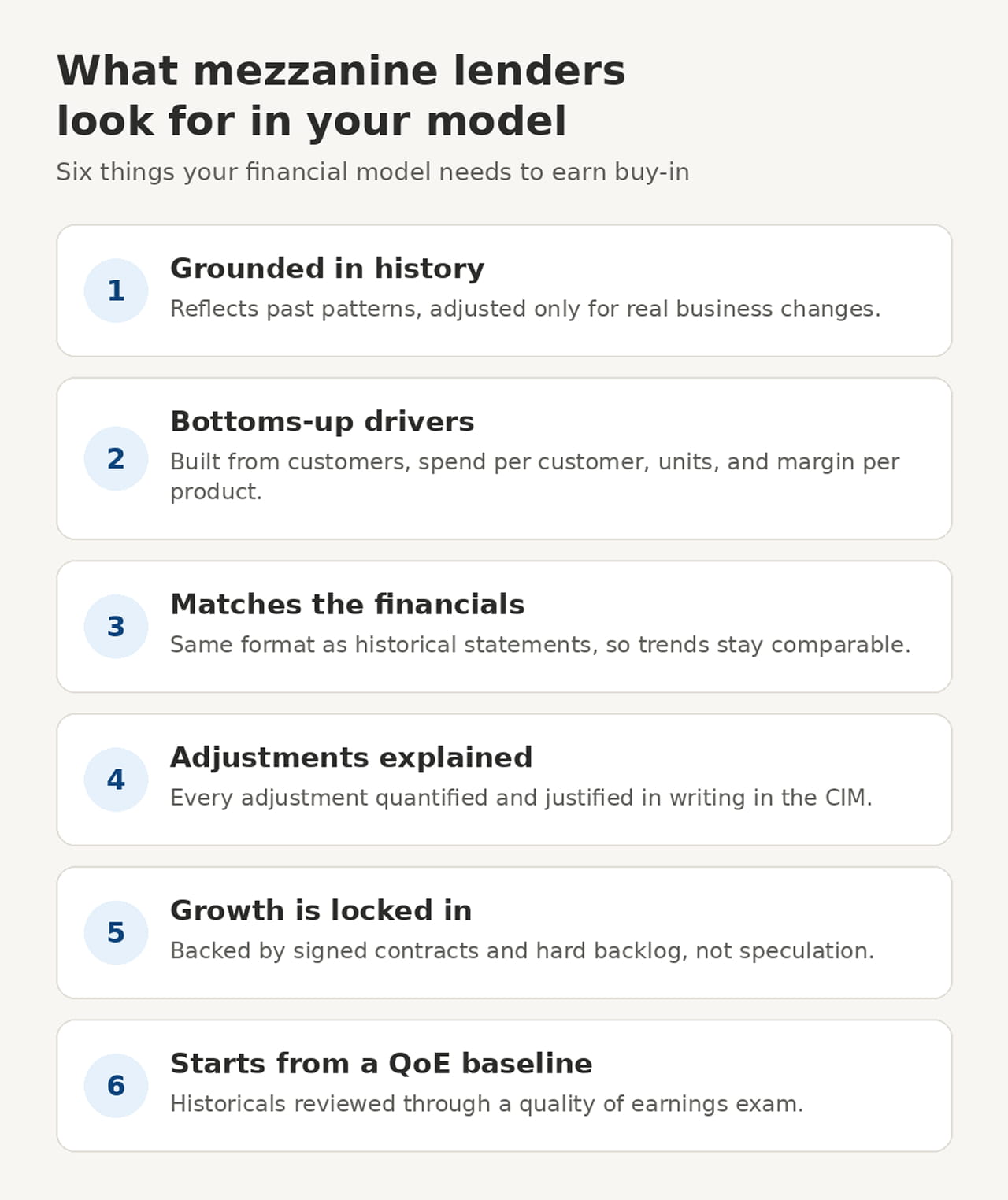
The mezzanine lender needs to see within your model an operating framework filtered through the actionable metrics of the business.
The more ambiguous the model drivers are and the growth path is, the less likely the mezzanine lender will buy into it.
The model should also be an extension of the company’s current financial reporting.
Ideally, the model should be in the same format as the historical financial statements, so the long-term trends can be analyzed.
When account line items are not comparable and the model is not mapped to the internal financials, its usability is limited.
Adjustments in the model should be clearly defined and quantified.
The model should have a written accompaniment in the CIM that explains what the adjustments are and why they are justified.
Often, models lack sufficient adjustment documentation leaving the mezzanine lender to intuit what the buyer is thinking.
The model should not be overaggressive unless the projected growth is locked in and clearly calculable.
Mezzanine lenders love growth that can be supported by executed contracts and hard backlogs, as it significantly derisks the deal.
However, you should not try too hard to make speculative new business sound guaranteed as there is many a slip between the cup and the lip.
Finally, the best projection models are based on historical financial results that have been through a quality of earnings exam.
When a mezzanine lender knows that the buyer has conducted their own quality of earnings review, they take the buyer’s financial model more seriously and often buy into it.