Background
 Strategic Funding Advisor
 Firm Expertise
 Practical Experience
 Legendary Customer Service
 Closed Deals
 Testimonials
 Business Funding
 Acquisition Funding
 Mezzanine Funding
 Advisory
 Mezzanine Funding
 Mezzanine Expertise
 Mezzanine Tools
 Acquisition Funding
 Acquisition Funding Expertise
 Advisory
 Case Studies
Mezzanine lenders are expert sleuths at exposing fancy financial engineering in deals. It happens very quickly almost before the investment banker is finished with the initial pitch.
Financial engineering is overly enthusiastic and wildly optimistic assumptions used in financial modelling. Inexperienced and junior finance types are prone to this as they overstate the deal to try to generate interest from Mezzanine Lenders.
Usually they create an overly optimistic set of addbacks to the historical P&L to inflate the EBITDA to a much higher level than the actual.
How Mezzanine Lenders Spot Financial Engineering
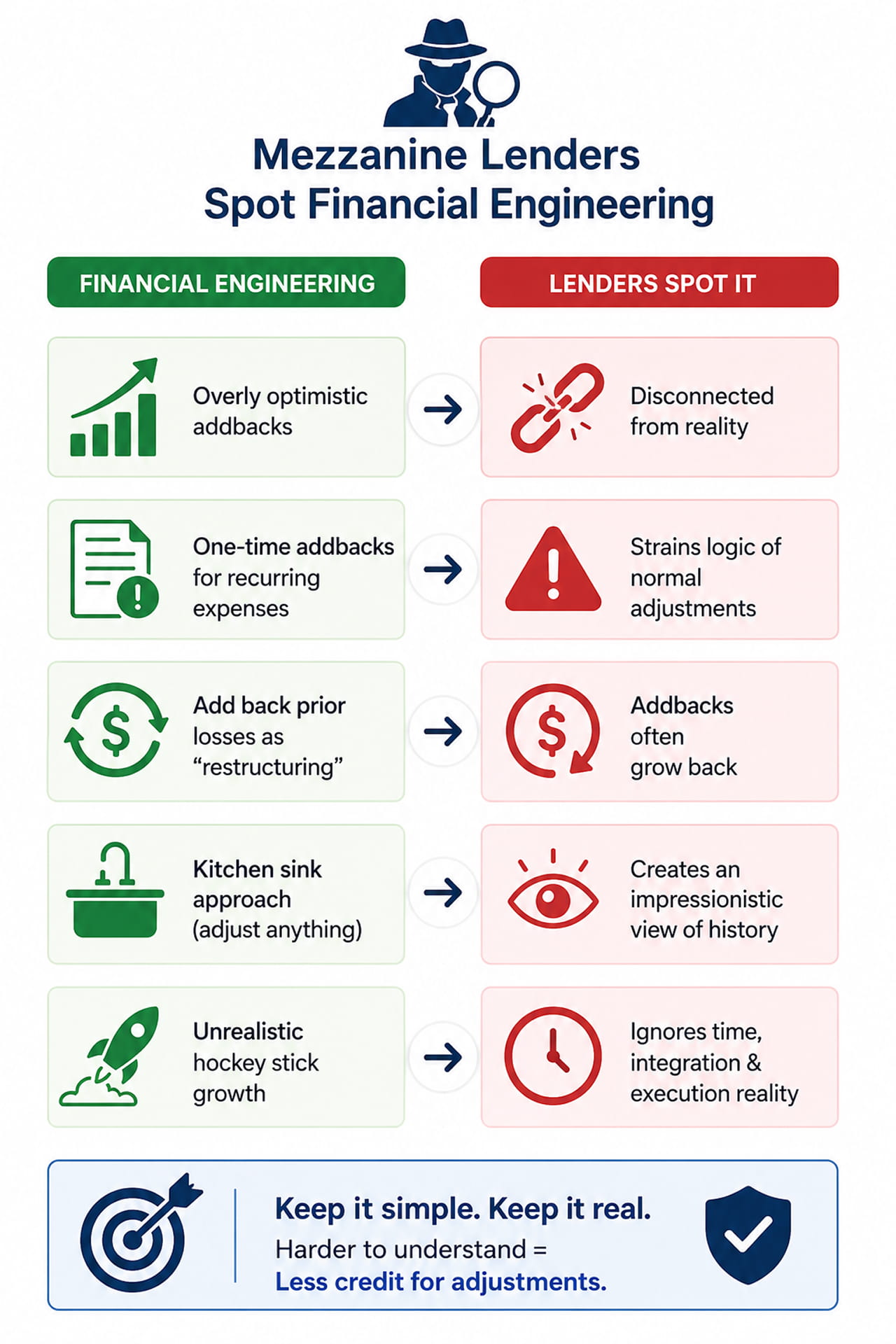
The dead give-away as to feeble financial engineering is a model wholly disconnected from the target company’s internal financial statements and historical ratios, especially with respect to balance sheet and working capital.
The financial posturing of these inexperienced finance types can strain the logic of conventional addbacks creating a wholly unrealistic view of the past.
These include justifying one-time addbacks for recurring, non-discretionary expense, recasting ordinary expense as extraordinary and allowing management to addback losses associated with bad business decisions under the guise of restructuring.
The reality of business is that addbacks often grow back albeit as a differently named expense. Unless they are documented clearly and easily captured, they usually slip through the cracks.
If management has learned and made structural changes from the prior business decisions, then restructuring addbacks can be justified. If the company is not chastened and still lacks discipline, then these prior losses should not be added back as restructuring costs.
Financial engineering that uses a kitchen sink approach to any and all adjustments render an overly impressionistic view of history.
Rookie finance types also usually underestimate the time factors and grow factors in their projection assumptions. Often companies with historical single-digit growth rates suddenly have hockey stick like growth rates in the first two years post-closing.
Despite the acquisition integration being very intensive and time consuming, and the ownership change creating cultural waves in the organization, revenue is expected to zoom ahead at 15% growth in year 1.
The key with financial engineering is to not get too fancy and overwhelming for the mezzanine lender. The harder it is for the mezzanine lender to understand, the less likely they are to give you credit for the adjustment.