Background

 Strategic Funding Advisor

 Firm Expertise

 Practical Experience

 Legendary Customer Service

 Closed Deals

 Testimonials

 Business Funding

 Acquisition Funding

 Mezzanine Funding

 Advisory

 Mezzanine Funding

 Mezzanine Expertise

 Mezzanine Tools

 Acquisition Funding

 Acquisition Funding Expertise

 Advisory

 Case Studies

While Lenders often make love noises to their borrowers about supporting them long term, the reality is closer to a short honeymoon. This is true when the lender gets acquired from a larger lending institution. This happened frequently during the Great Recession where asset portfolios were changing hands rapidly.
Most companies spend a good deal of time building relationships with their loan officer, only for the loan to be transferred to a different, usually far larger institution without any warning. This is jarring for a borrower at first, and it can go one of two ways.
If the borrower is highly reliant on their lender for capital, and the new lender is bigger and not set up well for relationship connection, the borrower needs to refinance as soon as possible. Most lender acquisitions take years to integrate, and the culture is very different post-sale so it will be challenging at best for the borrower to build up that trust factor again with the new lender.
If the borrower does not need much from the new lender and felt that the old lender was too much, it can work out well for the borrower. If the new lender only cares about the interest is being paid and that the financial statements are being sent to them on time, then it may be the perfect set up for the borrower.
The Work-Out Risk When Your Lender Is Acquired
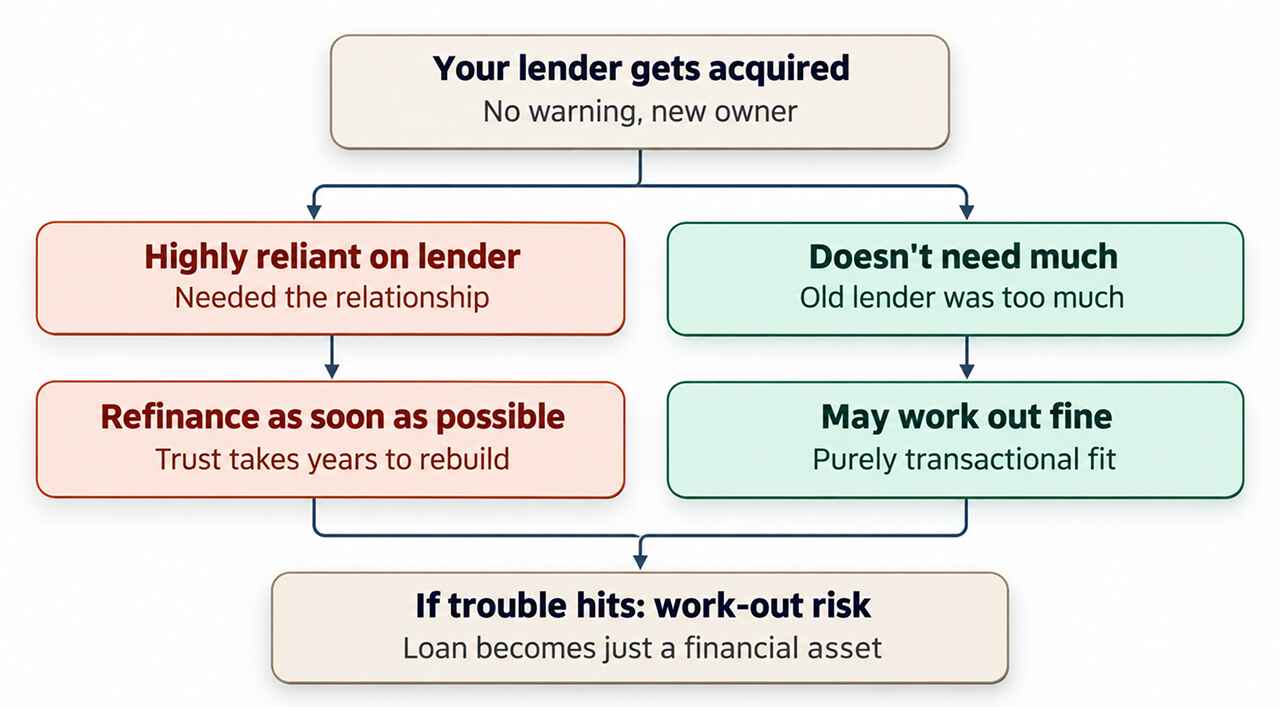
The big risk is how the new lender will act if you go through a rough patch with the business. Most acquirers of lenders are larger than the lender they acquired.
Private credit lenders do not have a lot of inhouse work out specialists on their payroll and use third parties. Large banks will have work out specialists on their payroll, but they may be accustomed to larger work out situations, as opposed to middle market size credits.
It is likely that the acquiring lender, whether a bank or a private credit fund, will have a very different engagement style in a work-out, and this fact is hard to know up front.
If the portfolio of loans acquired is not material to their primary lending strategy, it may receive less attention than it otherwise would. If, on the other hand, it is a focal part of their business, they may bring in very aggressive work out professionals. In either case, you will have little in the way of relationship capital with the work out team as the people who previously managed the relationship are gone.
Your loan in a sale scenario is reduced to a financial asset with a risk rating and seen through a very transactional lens. It is a far cry from the relationship-based love song that many lenders whisper to their borrowers on the front end.