Background

 Strategic Funding Advisor

 Firm Expertise

 Practical Experience

 Legendary Customer Service

 Closed Deals

 Testimonials

 Business Funding

 Acquisition Funding

 Mezzanine Funding

 Advisory

 Mezzanine Funding

 Mezzanine Expertise

 Mezzanine Tools

 Acquisition Funding

 Acquisition Funding Expertise

 Advisory

 Case Studies

Mezzanine debt, like all loans, has an advertised cost and a real cost. Most mezzanine debt lenders for lower middle market deals will say they target mid teens for pricing. This level of pricing makes sense due to the return on investment the borrower can generate.
What often happens is that the borrower focuses only on the interest rate and warrant level when analyzing the term sheet. They often do not focus enough on the true cost of the financing in a dynamic scenario where the loan grows rapidly through delayed draw and the borrower repays early.
Most mezzanine debt providers need to generate a minimum absolute return on their capital. When the loan gets repaid early, they have the right to get a fixed amount of interest regardless of how long their loan is outstanding.
Whereas the interest rate may be cash pay 11% and payment in kind of 2%, the effective interest rate could easily double if the lender gets paid for one extra year at the time of the take out. Often this prepayment amount is still well below what the company would pay if they had raised equity. So while it adds more cost to the refinancing, it is still a good trade for the company.
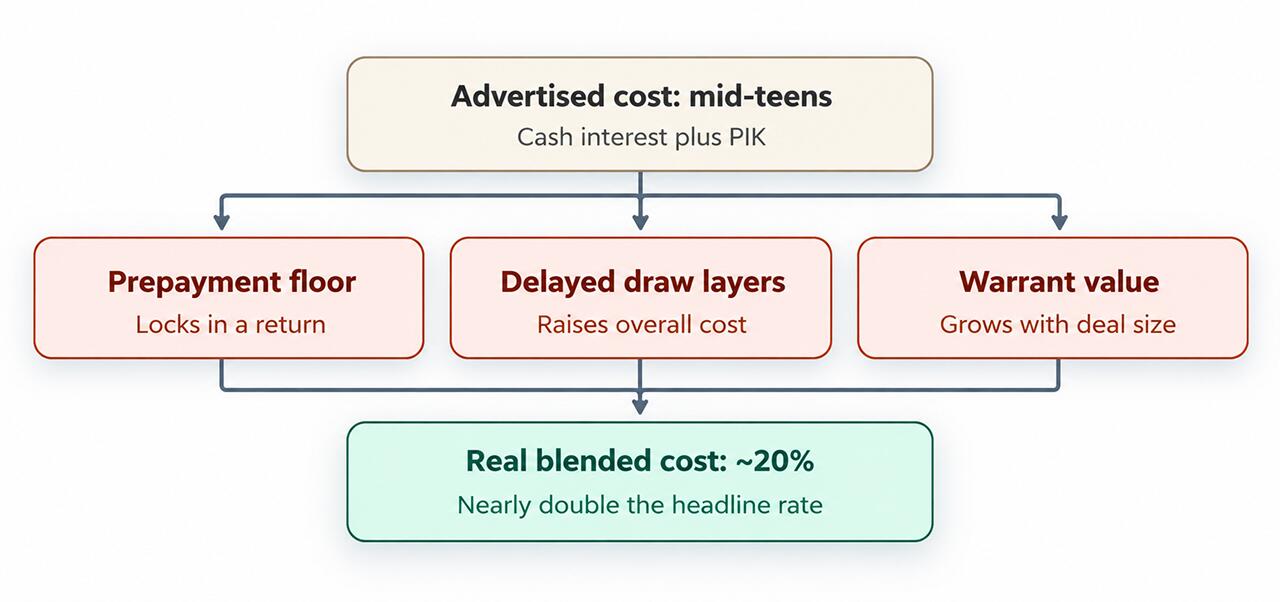
How Delayed Draws and Warrants Drive Up the Cost of Mezzanine Debt
When companies borrow more under a delayed draw, it also means that each layer of capital raised must meet the minimum return requirement, regardless of how close the advance occurs to the actual take out. This can really break the bank and it spikes the overall cost of mezzanine debt.
The ultimate cost of the warrant also weighs heavily on the overall cost of financing. At small warrant levels – generally under 2%, it is easier to negotiate a borrower-friendly value. As the warrant level increases over 5%, the lender is more focused on getting top dollar.
In rapid delayed drawdown situations, the company adds equity value with each acquisition closed. The faster and larger the roll-up, the higher the final warrant price is.
Most larger warrant deals that have minimum return protection generally sport 20% blended cost to the company.
If the Company has increased EBITDA and generated large increased equity value, mezzanine debt is still a great alternative, albeit more costly than originally thought.