Background
 Strategic Funding Advisor
 Firm Expertise
 Practical Experience
 Legendary Customer Service
 Closed Deals
 Testimonials
 Business Funding
 Acquisition Funding
 Mezzanine Funding
 Advisory
 Mezzanine Funding
 Mezzanine Expertise
 Mezzanine Tools
 Acquisition Funding
 Acquisition Funding Expertise
 Advisory
 Case Studies
Quality of EBITDA is more important than quantity of EBITDA to the mezzanine lender. Adjusted EBITDA is the sine qua non in the finance industry, without which valuation, lending multiples and M&A has no meaning.
Adjusted EBITDA is such a sacred cow that it leads to widespread overstatement, and loss of credibility. Mezzanine lenders see hundreds if not thousands of deals annually each with their own adjustment framework that articulates why adjusted EBITDA is legitimately higher than actual EBITDA.
Some adjustments such as owner’s salaries and personal expenses are straightforward and understandable. Others such as cost cuts and one-time expenses also are easy to believe but often get overused. Adjustments pertaining to an alternative vision of revenue and gross margin based on certain assumptions are too aggressive for many lenders.
Mezzanine lenders like dealing with low levels of adjustments where they do not have to work too hard to understand the bridge between actual and adjusted EBITDA. They shy away from deals where a large percentage of the adjusted EBITDA is adjustments.
The EBITDA Test Used by a Mezzanine Lender
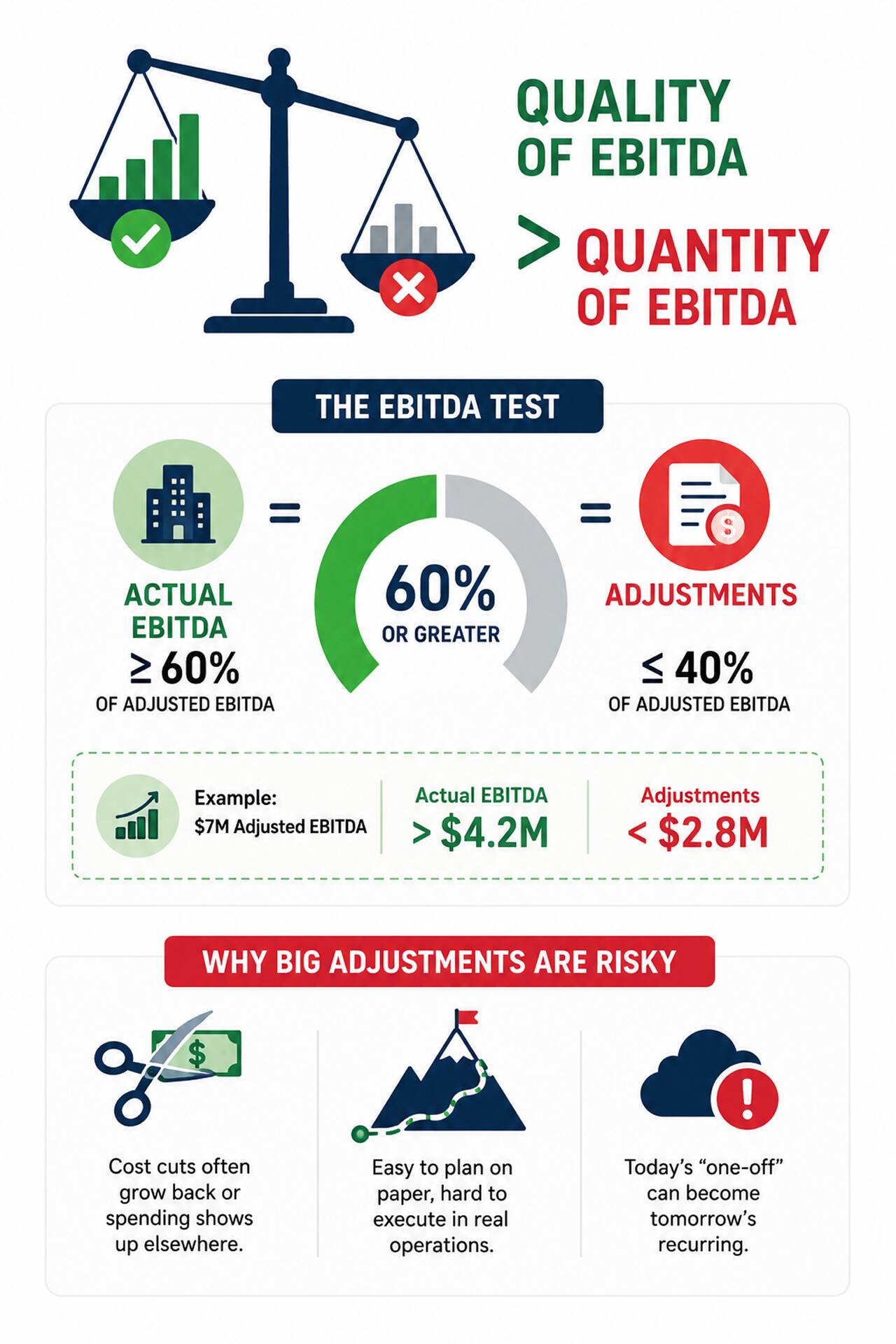
If a deal has $7 million of adjusted EBITDA and $5.5 million of adjustments, the lender will struggle to get there. The test most mezzanine lenders use is that actual EBITDA should be 60% or greater of adjusted EBITDA.
If the company has $7 million in adjusted EBITDA, its actual EBITDA should be greater than $4.2 million and adjustments less than $2.8 million. The lender will require a quality of earnings review by their accounting firm during diligence to test the company’s EBITDA estimate.
This usually results in discounting the level of adjustments due to the buyer’s overly blue-sky view of the world. The reality with adjustment is two-fold. Most cost cuts used in adjustments grow back or spending grows in another line item.
So while that specific cut may be locked, new spending grows in another place. Secondly, it is easy on paper to quantify and articulate cuts and revenue opportunity, but quite another thing for a company to make it happen operationally.
The adjustment theory of EBITDA sees historical events as one off and isolated. Those specific events may well be one-off but there is always something new and unexpected around the corner, which may take its place, creating recurrence.